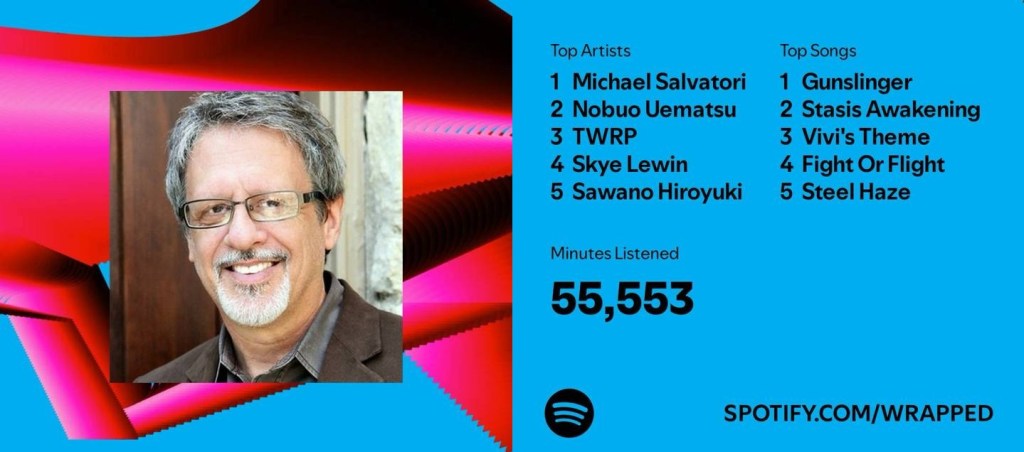
I have beef with Spotify Wrapped.
Not because it is naked engagement bait (though it is), nor because it has inspired an obnoxious plague of pretenders (though it has). No, my beef is because Wrapped does not understand me. It purports to summarize what I have listened to in a given year, yet the colorful lists it generates do not tell the whole story. Wrapped assumes I use Spotify to listen to music, and that’s just not true.
I use Spotify to play music, regardless of if I’m actually listening.
Most days, I pick a playlist (one I have made, never something algorithmically sourced) and turn on shuffle while I’m showering, doing chores or busywork, chatting with friends, or playing Slay the Spire (which shouldn’t be taken as a dig against Clark Aboud’s score). Anytime I’m doing something that requires focus but not quiet, I want something coming out of my speakers or piped into my headset.
With some exceptions, the only times I’m truly listening to music are when I’m in the car or on a walk. The rest of the time, I’m wielding music as a weapon against silence.
Therefore, Wrapped may be a statistically accurate summary of the music I played (on Spotify) that year, but it isn’t a completely honest account of my listening tastes and priorities. So, to set the record straight, here’s
What I listened to in 2024

Raven
Left to my own devices, I would listen to nothing but soundtrack music.
I have two giant disorganized playlists dedicated to doing just that—one called “Games” and one called “Anime.” I cycle between them depending on my current mood, and in years past it is from these lists that Spotify would generally pluck my Top Songs.
Last year was different, though. My year-end list was still dominated by soundtrack music, but the playlist that fueled those metrics was a separate, smaller list that I made as a sonic mood board for my D&D character, Raven.
I made the playlist back when I was still writing out Raven’s backstory and getting a sense for who he was. He’s more than a little Cayde-6 coded, so there’s plenty of Gunslinger and Exo motifs from various Destiny soundtracks, but he also exhibits a splash of existentialism a la Vivi from Final Fantasy IX.
Starting from the mechanical body of a warforged, I was already adding in some Armored Core logic to his design, so why not bring in some of the themes from that game to remind me about the perils of power without purpose?
And then I had a running list of a few other archetypes to jam in there: Hyper Light Drifter’s somber meditation on what it’s like to carry on long after the world is ruined; Mega Man Zero’s reawakening of a legendary hero who discovers that a story doesn’t end just because you go to sleep; and the discovery of secrets that perhaps should have stayed buried in Tunic and Undertale.
I kept throwing things into the pot and giving them a taste with my ears, and eventually what started as a melange of vibes started to coalesce. Songs began to slot into a sequence, a chalk outline of a man and his story. Beat by beat, I could see what notes I might want to try hitting, if the DM and the dice allow it.
The end result is an electronically-driven portrait of an ancient warrior turned vagabond who has as much potential for heroism as he does mechanized violence. Having finished the backstory, now I listen to the playlist when I want to get into the zone before sessions. I shared it with the DM, too, and it inspired him to plant certain narrative seeds in the world of the game.
This little exercise was so effective that it will probably be a new best practice when I make characters going forward. In fact, I already made another one for a different character last summer.
Soundtrack music has a transportational quality. It both evokes its own context—so I can recall the scene, character, or setting that a particular theme is referring to—and it also invokes a mood, a feeling, a sense of purpose. With evocation, it’s satisfying to summon memories of the stories I’ve experienced, but Raven’s playlist is the first time I feel like I’ve tapped into that power of invocation.
Removed from its original context, how could I bend music to my own ends? Sometimes there’s more fun to be had by ignoring the instructions and drawing my own picture over a series of unconnected dots. In so doing, I graft story over a void that once rang silent.
TWRP
Few things inspire listening so much as seeing a band live. After years of enjoying Canadian disco rock group TWRP, I finally got to see them live last April. The show was more fun than I could have hoped, the crowd was among the best I’ve been part of, and Doctor Sung is as short as his kicks are high.
TWRP was supporting their latest album, Digital Nightmare, and as you might expect from a costumed band, their live show was far more than a rote recital of their song catalog. I had heard the Groove Crusaders bring a certain theatricality to each set, and for this tour, Doctor Sung was very excited to announce that he had just become a spokesperson for International Business Systems.
Sung’s sponsor had asked him to demo an exciting new AI-powered platform called GROBB at the show.
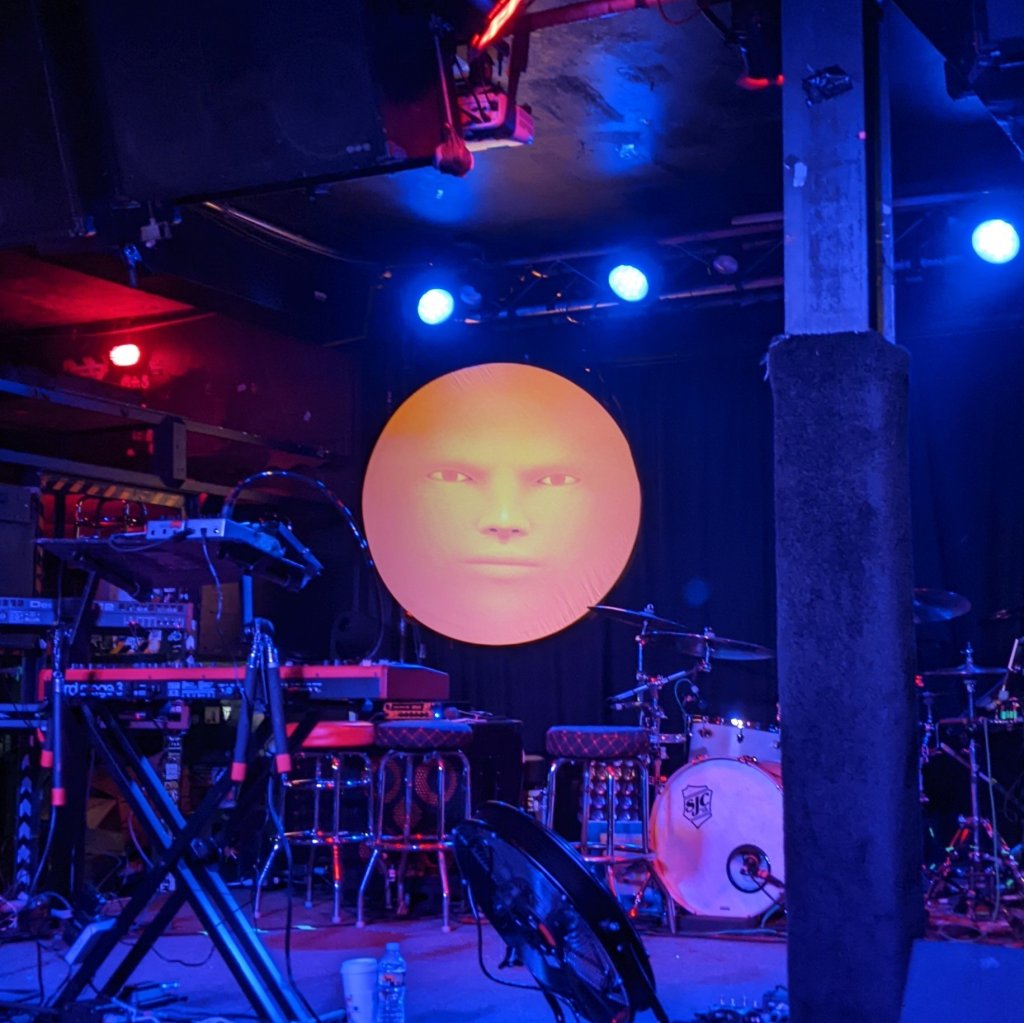
Between songs, GROBB repeatedly demanded that Sung re-up on GROBBcoin to continue the performance, at one point forcing him to liquidate his savings. As a brand ambassador, Sung’s contract also stipulated that he showcase GROBB’s built-in social network, only for other users to shower him with insults to his person and costume (“It’s actually armor!”).
It seemed like the band was carrying out some kind of satire, but I can’t for the life of me tell you who the target was. I suppose it will remain a mystery.
Regardless, I had a great time hearing them play. Doctor Sung’s antics make him an excellent showman, Lord Phobos is surely a virtuoso guitarist on Earth as well as his homeworld, and the mechanical precision of Havve Hogan’s drumming underscores the band’s otherworldly groove.
But there was a standout performer on the stage, and his name is Commander Meouch.
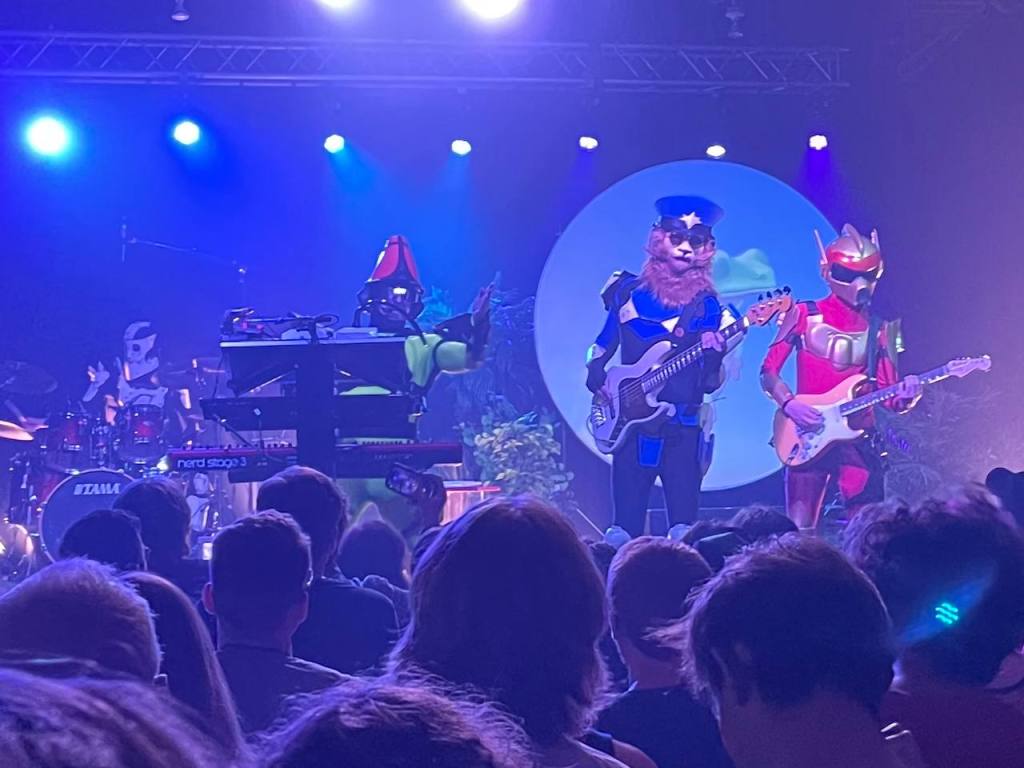
Bass is the lifeblood of funk, and that makes Meouch the heart of the band. He alternates between pumping out filthy licks and pumping up the crowd, and it’s clear he embraces his role as the band’s second-in-command.
TWRP’s best songs are those where Meouch is unleashed, as heard with the driving propulsion of “Hidden Potential”, the urgent evolution in the band’s cover of “The Eve of the War”, and the pure display of power in “Time to Shine”. That cat man really knows how to lay down some grooves.
I put together a playlist of my favorite TWRP songs as I was leaving the venue so I would have relevant tunes to drive home with, and over the course of the next week I added some other bona fide jams to the list. A little bit of Magic Sword. Some LCD Soundsystem. Trey Magnifique (one of the openers from the concert). Tom Cardy. Soil and “Pimp” Sessions. Justice.
Once I had a nice playlist of music to move to, that became my stopgap against silence for the next couple of months.
Raven’s mix
Sorry, we have to talk about Raven some more.
See, Raven is a warforged, which is basically an android for fantasy settings. He’s different from other warforged, though. He’s no mere automaton—he carries a soul, one not native to his frame. And strange things happen when that soul comes into contact with lost memories.
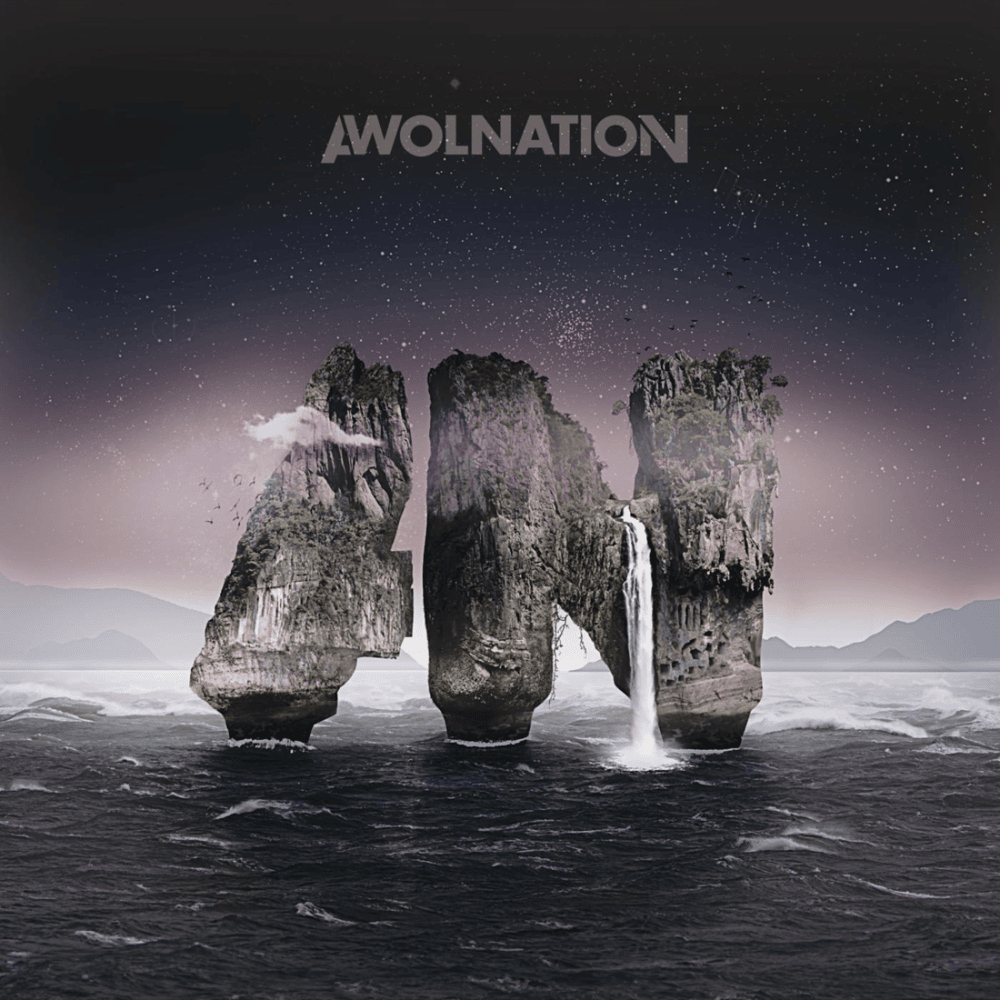
One such memory involved the DM playing “Knights of Shame” by AWOLNATION, a song I had never heard before. And as significant as this moment was for Raven, it had an effect on me, too. Something about this song uncorked a memory hole in me, the player. I wasn’t familiar with it, but it reminded me about music I hadn’t listened to in years.
After the session, I made a playlist and added a couple of songs to it, and those songs reminded me of other songs, connecting on down the line for reasons I would struggle to explain.
“Spitting Venom” led to “Show Me How to Live”.
“Shadow Stabbing” led to “Cygnus…Vismund Cygnus” led to “Hide and Seek”.
“Wish You Were Here” led to “Demon Cleaner” led to “Know One Knows” led to “The Raven That Refused to Sing”.
And on and on until I had a playlist 3 hours long.
Not every song was something I had forgotten, but others forced me to dig out a hard drive and look through folders of music from the iPod I stopped using years ago. How else could I have rediscovered Jaga Jazzist or “F.C.P.R.E.M.I.X.”?
I felt compelled to add a few more contemporary items that still seemed to fit, although taking a wide view I’m still not exactly sure what ties it all together. There’s definitely a proggy bent throughout much of the list. Perhaps there is an undercurrent of anger or sorrow, yet little to no angst.
I wondered: If the soul Raven carries remembers “Knights of Shame”, perhaps it would remember some of these songs, too.
This mix only stuck with me for a couple of weeks, but for a time I wandered through the backrooms of my memory, content to know that silence had not claimed this space between selves.
Chris Christodoulou
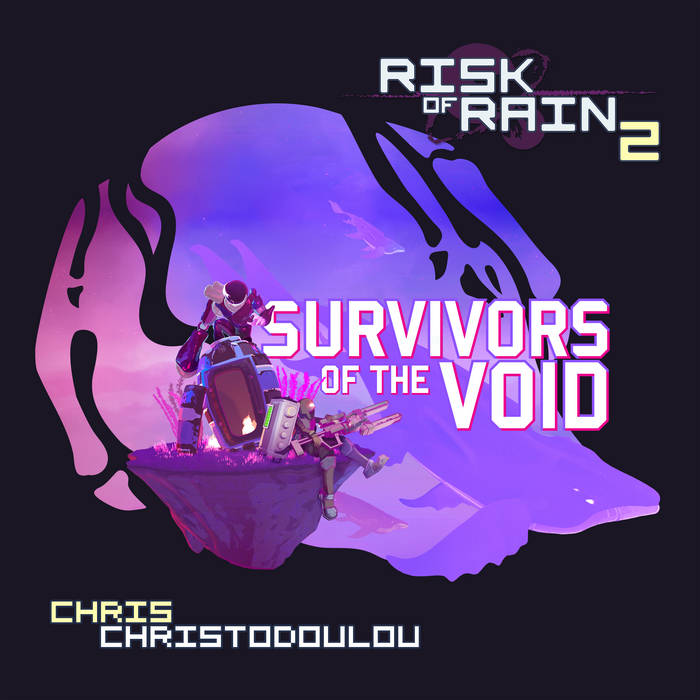
I like to imagine Chris Christodoulou didn’t know what he was signing up for when he agreed to do a soundtrack for Risk of Rain.
“Video game music?” he might have said. “No. You need prog.”
And then he proceeded to write some of the best prog music of the last decade for a game that would be a shadow of itself without his contribution.
But the real kicker is he did understand the assignment.
Christodoulou has published commentaries explaining both the deep well of influences he draws from as well as the way the motifs for different themes, places, and characters are woven throughout. His music accomplishes both what prog rock should do, which is take you on a journey, and what video game music should do, which is ground you in the world and moment.
There’s something else Christodoulou’s work accomplishes, and it’s the reason I listen to him every day (though Spotify is none the wiser).
At the end of the night, when I’m ready to turn out the lights, I bring up YouTube on my phone and find the video for “Once in a Lullaby” or “The Rain Formerly Known as Purple” or “The Raindrop That Fell to the Sky”. I set my phone on the bed stand and turn over, letting the spacey tableau of synths and guitars ferry me from roiling thought to placid dream. Thus do I cross the gap between silence and sleep.
Nintendo Music
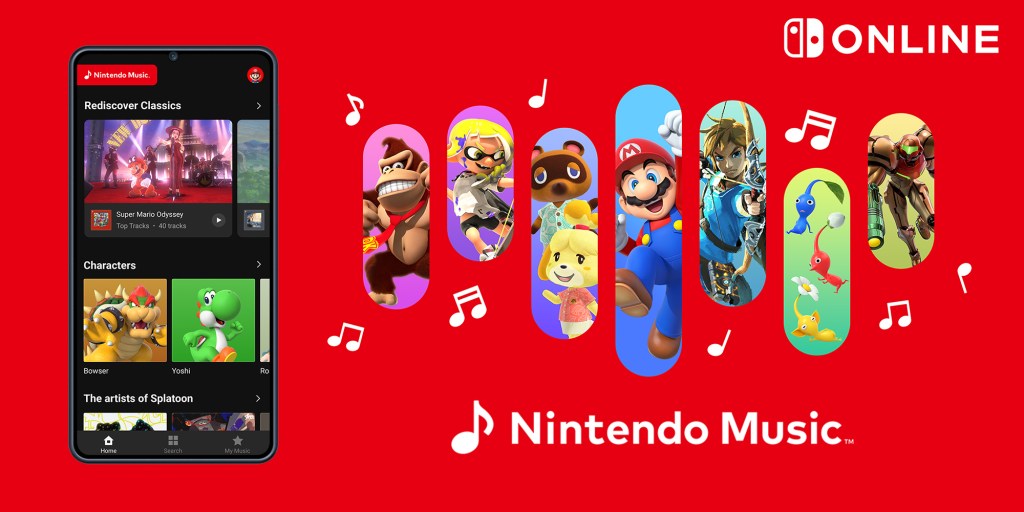
Lest you think I mean I listened to a lot of Nintendo music last year, I will immediately clarify that I am referring to the app, Nintendo Music, and I am including this section not because I found the app useful but because I find it abhorrent.
Nintendo is infamously one of the most litigious companies in the video game industry. Fans are no better than pirates where Nintendo’s intellectual property is concerned, so fan games, grassroots tournaments, and more are all under constant threat of being struck down with a hail of cease and desist letters.
Naturally, this policing also extends to attempts to catalog Nintendo’s extensive and beloved library of game music.
That’s all the music from iconic series like Super Mario Bros., The Legend of Zelda, Star Fox, F-Zero, Metroid, Kirby, and so on. We’re talking about anything by Koji Kondo, any soundtrack composed by a ringer (Yoko Shimomura’s Super Mario RPG soundtrack comes to mind), or any of the work by composers whose names you don’t know because Nintendo has a vendetta against crediting people (remember this).
Now, prior to last year, was there an officially sanctioned place to listen to any of that music? Don’t be ridiculous.
Sure, they might put out an album of orchestral Zelda music to commemorate an anniversary, and Masahiro Sakurai might take it upon himself to include a music player mode in Super Smash Bros. Ultimate that turns your Switch into a giant mp3 player. But Nintendo has never made their music widely available for streaming or purchase in the way that basically every other publisher does.
The only place to listen to Nintendo music without venturing into the back alleys of the internet was on YouTube, where whole channels are devoted to doing what Nintendo refused to do. Every so often, a wave of strikes would go out and some of those channels would disappear, only to be replaced by a new crop of dedicated jukeboxes. All the while, Nintendo took and took without offering legitimate alternatives.
Until last year, when they announced Nintendo Music, which is a music service as only Nintendo could devise one.
To start, the app is an extension of Nintendo Online, which isn’t the most costly online service in gaming, though it is perhaps the least worthwhile.
The app is also mobile only. There is no desktop equivalent or even a web portal, so there is no way to stream music from the app to a PC. Maybe that’s not an issue if you’re often on the go, but I work from home and my computer is my most used playback device. An app that only exists on my phone is one that gets little use.
Worse still is what the app actually offers. At launch, Nintendo music featured soundtracks from 22 games. For a company with decades of creative output, 22 games is next to nothing.
Since October, they’ve added roughly 4 soundtracks a month, setting precedent for a drip feed of music, most of which is probably not what people like me are gunning for. Sure, by all means, add the soundtracks to Brain Age and Nintendogs. They couldn’t be bothered to whip up anything as catchy as the Wii Shop music for the Switch’s online store, but at least we can listen to that Wii Shop track on the app.
Only the biggest hitters were present from the get go. There’s Ocarina of Time and Breath of the Wild, Super Mario Bros. and Donkey Kong Country. I’ll even give them credit for Splatoon—that series has ardent fans.
But selfishly, I have to ask: Where is Majora’s Mask? Where’s Super Metroid? What about Kirby Super Star? Where’s the music from any game in the Paper Mario series?
I can accept that this app probably hasn’t been in the works for very long. It would take some amount of work to get every soundtrack into a state fit to upload and stream from the service.
But the cynic in me can’t help but see a hostage situation where Nintendo expects people to hang on and keep paying in hopes that their favorite game will finally be featured.
And the final straw for me is that the app doesn’t offer any credits to the composers of any soundtrack featured therein. Each song has a track info screen, but the only things listed there are the title, the game, and © Nintendo.
They’ll use this app as a cudgel to strike down their music anywhere else it pops up, but they won’t even credit the artists who made that music in the first place. Doesn’t matter if you’re Koji Kondo or Kenji Yamamoto, Grant Kirkhope or David Wise—that work belongs to Nintendo, a company that breaks its silence only when it has the full force of copyright law on its side.
IDLES
A friend of mine introduced me to IDLES way back in 2019 and my first impression was that they were abrasive in a good way, but they didn’t cement themselves into my listening habits right away.
Cut to this year and one of their new songs popped up into my feed. I checked and they had put out 3 more albums since the last time I had tuned in.
Later, I texted that friend and our exchange went as follows:
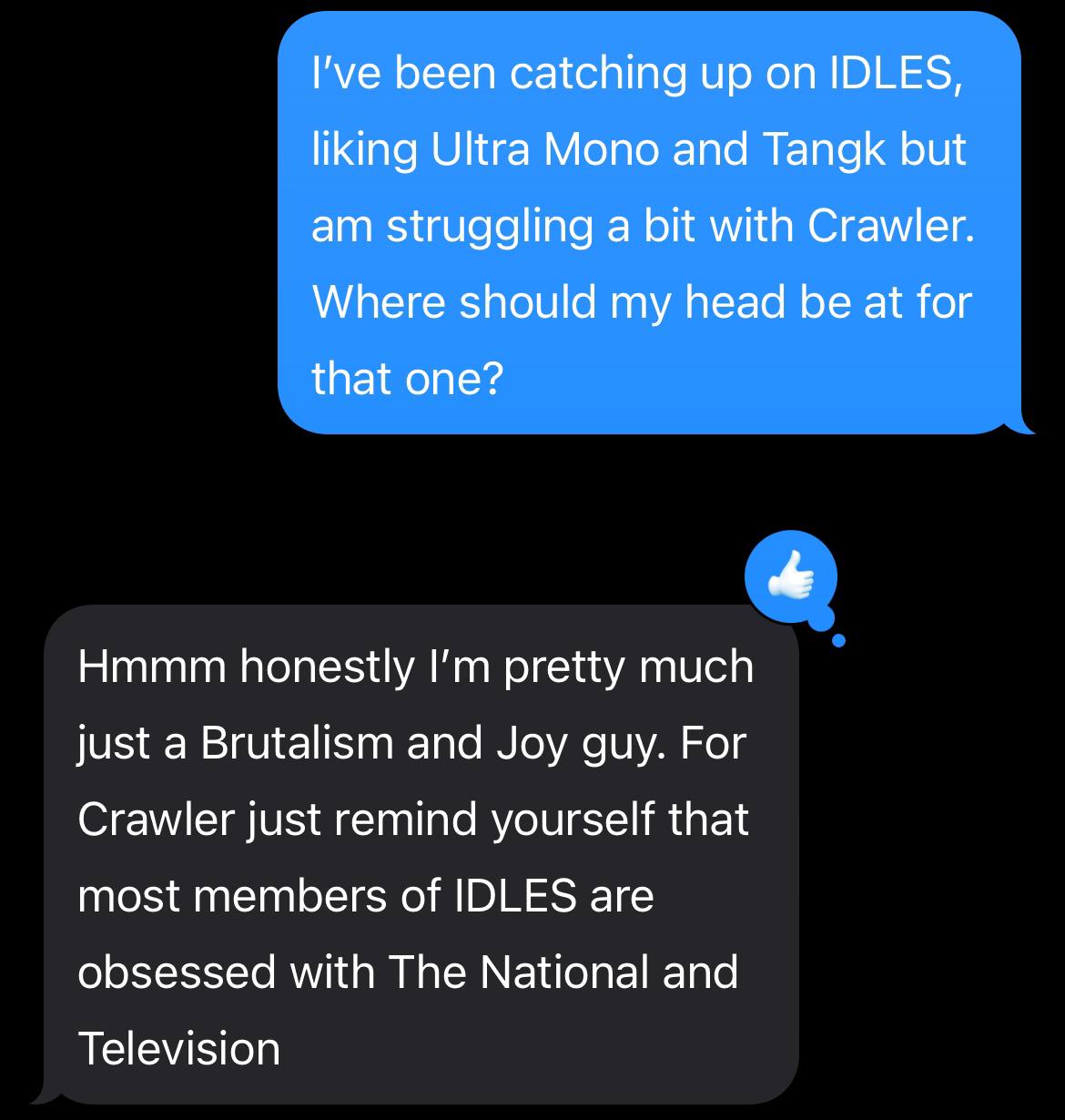
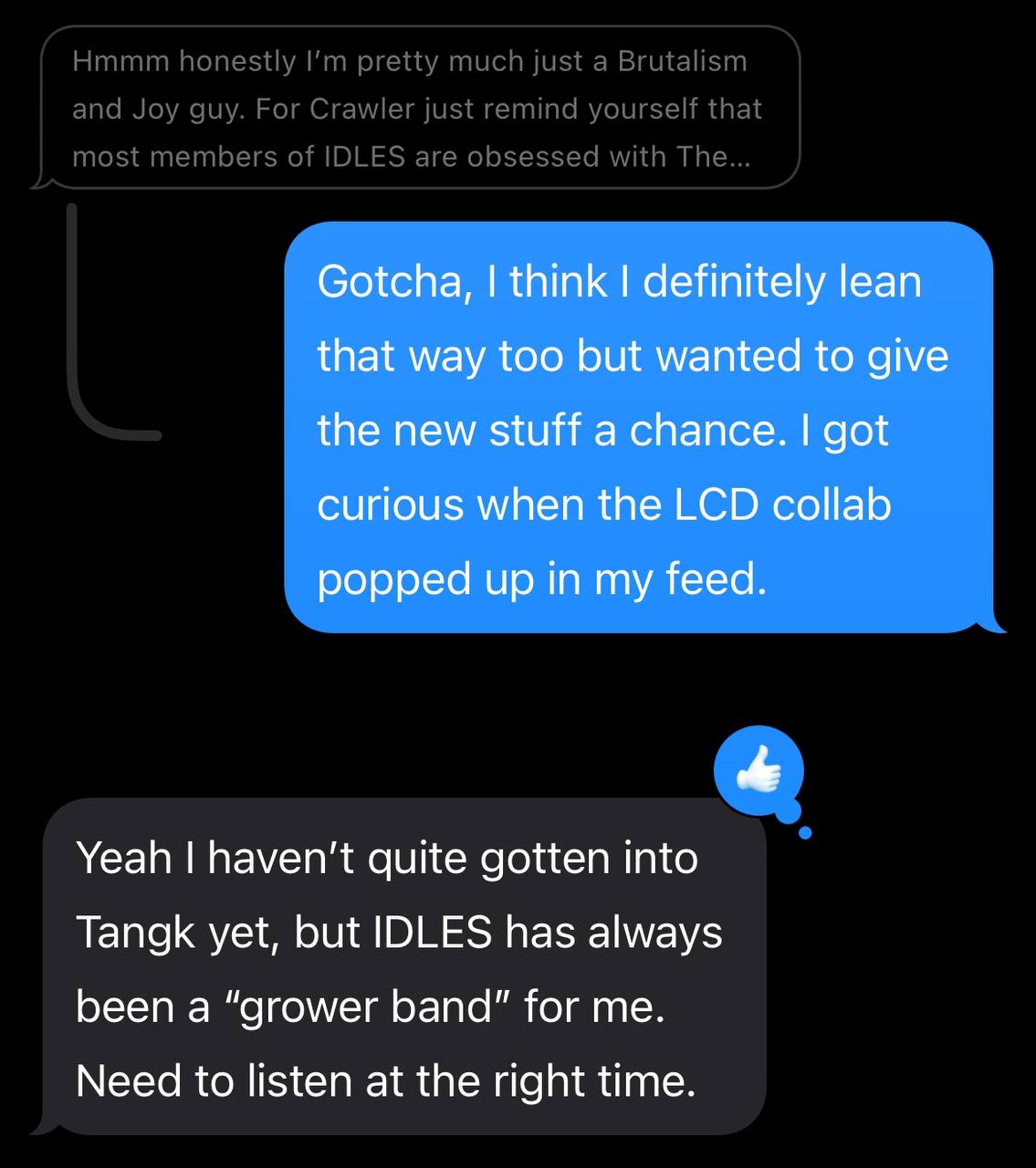
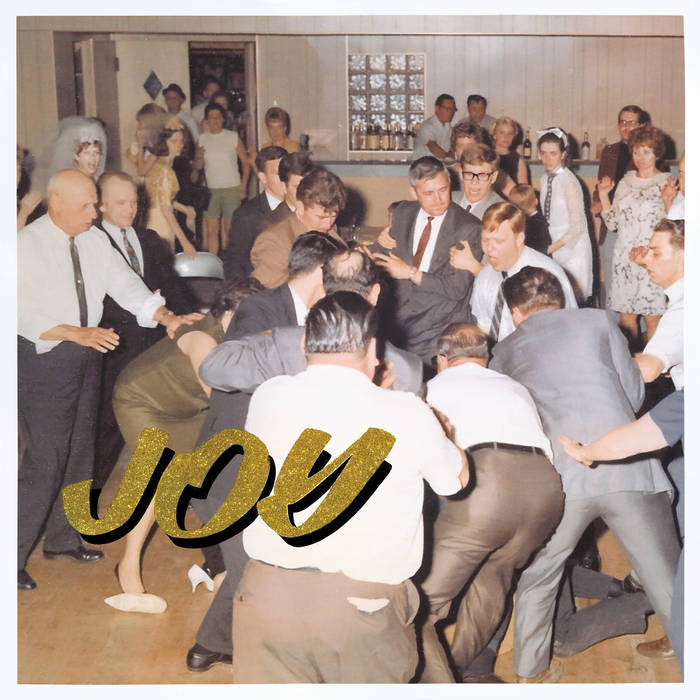
Joy refers to Joy as an Act of Resistance, the band’s breakout album and, at this point, still my favorite. It also stands at a particular point in their career, the spot beyond which a band becomes just a little too polished. Compared to Joy, Ultra Mono sounds kind of shiny.
I don’t have the technical know-how for how music is recorded and mixed and mastered and so on, but when I say “it sounds shiny”, I’m trying to refer to a broad quality that music takes on where it loses some texture. It feels slippery, like it would hit your eardrum and slide off without making any real impression.
Maybe I’m describing the act of selling out, or perhaps I’m gesturing to the moment a band runs out of ideas and has to remix itself into oblivion. Whatever the case, shiny music is less satisfying, like eating empty calories.
Sidebar: All pop music is shiny.
That extra layer of polish especially doesn’t suit IDLES. They’re better heard unvarnished, which is why I think if you want to get into IDLES, you first have to listen to them live. That’s the best way to understand what their music is supposed to be.
It’s meant to be a group of rowdy dudes stomping around the stage like a herd of wildebeests. One of them runs in place while yelling “LOVE YOURSELF” at the crowd that has gathered. It’s an incitement to kindness.
The right time for me to listen to IDLES was while I prepared for a certain D&D one-shot adventure, one where I was playing a were-badger barbarian. The other way I prepared—rereading Lord Brocktree—helped me immerse myself in the mystique of the Badger Lords I wished to embody. But listening to IDLES helped me become a barbarian by recognizing the voice of rage.
Which is not to say that IDLES is an angry man band. They reject that label, and they don’t want to be called punk either. Discordant as their music can be, I don’t even think it’s that transgressive.
But it is indignant. It beggars belief that we still need songs such as these. Songs that are wrathful only because the ideals they put forth—that we should care about other people, that we should stand together, that we should be unsparing in our love for one another—are radical in the world we happen to live in.
It’s the height of absurdity that someone speaking these truths must roar until they’re breathless. They must pound on the strings until their guitars scream and beat dents into the heads of their drums. The only way to shatter the deafening silence is with this warcry for solidarity.
Podcasts
As somebody who always resented when the adults who drove carpool would put on talk radio, I never expected to get into podcasts. Maybe those adults were onto something, though—commuting is what made me into a podcast listener.
There’s something specific about the early morning stop-and-go drive that makes it feel more like time for a podcast than a playlist. Highways and the open road—those spaces call for the momentum of music. But when I was just on my way into work, I found myself wanting to sit in on an interesting conversation.
By no means did I have the world’s longest commute, either. It was just long enough that over the course of a week I could listen to an episode of Kotaku Splitscreen (RIP), a Strong Songs, and most of a Waypoint Radio (RIP). The next week, new episodes would come out, and I would move on to those.
And then the world changed. When I stopped needing to commute, I stopped listening to podcasts as often.
There are still podcasts I want to listen to, though. There’s Remap Radio, which carries the torch of Waypoint. The next season of Andor is coming out soon, and A More Civilized Age offers the most cogent coverage of that show. And Worlds Beyond Number consistently delivers the pinnacle of actual play D&D.
Without having a de facto best time for podcast listening, I’ve taken to listening to them wherever I can fit them in. Occasionally my Sunday walk, instead of music. While I’m cleaning my apartment or cooking. In rare instances when I have some thoughtless busy work to take care of.
But more often than anything else, I put a podcast on after I’ve gotten into bed, stealing time from tomorrow while I listen and play solitaire. The cat likes to come curl up on my legs while the chatter carries on, gentle purring and genial prattling each serving to postpone the advent of silence.
Opeth
Every year, I return to Opeth, usually in the wetter weeks of late autumn. No music is better suited to that season than death metal.
No, not that kind of death metal. Yes, there are different kinds. You might be thinking about the kinds of death metal that are about violence and killing, carnage and bloodshed, impending doom, festering rot, or vikings.
For Opeth, death metal is built on bleakness. Theirs is a death metal of marcescent leaves, faded photographs, and grave wax. It is a music most concerned with vengeful ghosts, fraught relationships, weeping children, and other hallmarks of Swedish misery.
It’s also characterized by contrast. Frontman and songwriter Mikael Åkerfeldt understands how bright spots give weight to darkness. An acoustic interlude or a mellotron accompaniment makes an ensuing down-tuned riff that much heavier, and delicate melodies lay the groundwork for harsh vocals with greater resonance.
Opeth finds brutality in beauty, beauty in brutality.
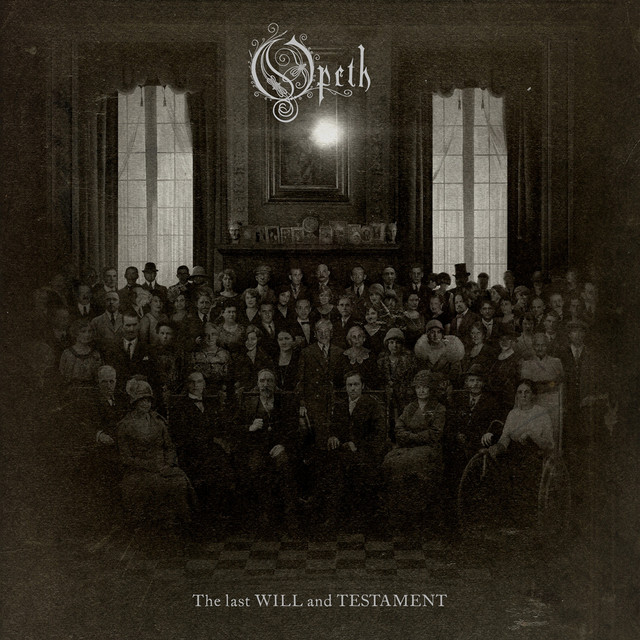
We’ve been waiting a while for a new Opeth album, and I’ve been waiting more than 15 years for an album where Åkerfeldt was interested in harsh vocals again. Post-Watershed, he seemed to feel like he had done enough screaming. The ensuing albums are still bleak, but they took on a more soulful tone while Åkerfeldt sought to capture more inspiration from the 70s rock he grew up on, bands like Deep Purple and Jethro Tull.
Every band has to evolve its sound from time to time, but I was glad to hear that deep, rumbling growl return on the leading single for The Last Will and Testament.
Speaking to Kerrang!, Åkerfeldt said:
Screaming, for me, is almost like rapping in a way. Not that I’m a good rapper, but the whole rhythmic thing I think is interesting. I’m very particular with the screams. They have to be good. They have to be specific. I have specific taste when it comes to those. And also, of course, it has to add to the overall idea of the music. This time around, because it’s a concept record, it does that.
Elsewhere, I’ve heard him say he’s “only interested in music that conjures emotion,” which makes me think it’s the specific combination of cadence and concept that brought Åkerfeldt back to the abyssal registers of his voice. From time to time, we all have to turn over old stones to get into character.
I enjoy the new album not because it is a return to form for Opeth but because it is an elegant fusion of their classic sound with the jazzier sensibilities of their 2010s work.
There’s more than a few wicked riffs on Last Will, but there are also lots of sections driven by strings. There’s a harp solo, and several appearances of a flute (played by Ian Anderson, no less, who also contributes spoken word performances across the album). Meanwhile, Åkerfeldt balances haunting howls with clean vocals that push into an almost operatic quality—track to track, I’m not sure which is more sinister, his screaming or his singing.
Overall, the record is a welcome addition to the rotation, one that I’ll come back to next time November sounds its baleful dirge.
It’s easy to know that a band is your favorite when they’re equally capable of surprising and comforting. All it takes is pressing play to set things right—else, silence reigns.
All to Thwart Silence
My ears do not remember what silence sounds like.
I remember, mostly. Although, in our bustling world, silence usually isn’t.
Instead, it is a chance to hear what I otherwise wouldn’t. Measured breathing. The whirring of fan blades in my PC, in the walls, in the A/C units outside my window. The dull hum of old stereo speakers. A puddle receiving gutter water. My own heartbeat.
Even if I were to venture out into what passes for wilderness, I would hear the droning of insects, the warbles of birdsong, wind rustling treetops, and perhaps the distant echoes of traffic on a highway.
Yet there is still silence—a space, no matter how small, between all the other noises that is their lack.
And I can’t hear that. Not anymore.
Part of me still expects to hear it, though. And in the absence of silence, that part of me cues up an alternative: a single high note, held to eternity without rest. It is the note devastation plays in movies following a proximate explosion or blunt force trauma. It is the encore to the encore, the only earworm that will truly stick in your head after a concert. It is my own personal Larson effect.
This is how I am given to understand chronic subjective tinnitus.
Writing in the Journal of Clinical Medicine in 2023, Park et. al. offers a consensus explanation:
Following cochlear damage, the according reduction in auditory nerve output is proposed to initiate a neurobiological signaling cascade resulting in hyperactivity in the central auditory system encoding for tinnitus. Thus, it is possible that the loss of cochlear afferent activity liberates involuntary, internally generated percepts in the brain, similar to the neural mechanism for phantom limb pain.
(In place of citations, assume anything that sounds factual from here on came from this paper.)
It’s estimated that 14% of people experience some form of tinnitus, and 2% consider it a serious problem. I feel fortunate that I’m among the 14% and not the 2%. People living with tinnitus are more likely to be depressed, anxious, and suffer from insomnia, but the only night I’ve lost sleep over the ringing was the first night I realized it hadn’t stopped.
At the time, I lived within walking distance from an Ear, Nose, and Throat clinic (I haven’t moved—the clinic did). I booked an appointment to see if there was a way to confirm a diagnosis or provide some relief, and when I went in they wanted to test my hearing.
They put me through what I gather is the standard test—sit in a soundproof booth, put some headphones on, raise your hand when you hear the beep… and I immediately knew I was going to struggle with this test.
Afterward, the PA let me know that I had demonstrated higher than average hearing loss for someone my age, which could be true. I went to enough concerts throughout my 20s, and while I always wore earplugs (thanks to my brother setting a good example), I would only wear them for the openers. For the headliner, I wanted to hear everything (I have since become a full show earplug wearer and, of course, concerts are no less enjoyable. Try telling that to a 20-year-old, though).
The part of the test I object to is the beep. Tinnitus sounds different to everyone. Some folks hear buzzing, some hear something more like radio static, and for others it can be a rhythmic thrumming. As I’ve said, I hear ringing, and the beep I was meant to listen for was almost the same exact pitch as that ringing. That booth was less a test of hearing and more an exercise in madness.
The ENT didn’t have much to offer me, and that tracks with the current treatment options for tinnitus. They said I could come back and get fitted for hearing aids, which is one of the most recommended routes. It makes sense, too. If tinnitus stems from hearing loss, then treating the latter could resolve the former. Except there’s a couple of issues here.
First, there isn’t a linear relationship between hearing loss and tinnitus. Plenty of people who hear just fine (like me) experience tinnitus, and some people with severe hearing loss do not experience it. There’s not a lot of strong evidence that wearing hearing aids guarantees relief.
And second, the first point is moot because, for the time being, I’m too damn vain to wear hearing aids.
Other treatment options are either infeasible or experimental. Cochlear implantation? See point 2 and 1 above. Electrical or magnetic stimulation? No thanks. Drugs? I’ll pass.
The topline intervention for tinnitus is cognitive behavioral therapy, which OK, fine—any excuse to get more people in therapy. But as you can probably guess, CBT doesn’t treat tinnitus, it treats the stress from tinnitus. And I’ve figured that out on my own.
That’s what Spotify is for.
Or any other stimulation. This whole post is about what I listen to instead of paying attention to the ringing in my ears, but it doesn’t need to be music or a podcast. A good conversation is all it takes, or even a compelling train of thought. I certainly don’t think about tinnitus while I’m 7 tabs deep on the Gundam Wiki.
My mom’s ears ring, too, and so do my grandmother’s (There are some studies about the inheritability of tinnitus, though none have confirmed a genetic link). I was talking to my mom about it recently, and she had more or less the same conclusion. As long as she has something else on her mind, the ringing doesn’t register.
That conversation made me wonder: How many other people do I know that are just living with it? Do other people get spikes of anxiety when their friend’s microphone cuts out? Have they become more sensitive to the shrill trilling of crickets? Or are all 14% of us too concerned with the rapid deterioration of our society to bother worrying about the gradual deterioration of our bodies?
My less than articulate closing thought is: I’m glad music is a thing.
What a godsend it is to live in an era where music is plentiful and playable at will. What a champion you are if you make or have made music. What would we do without music to weather-beat the jagged corners of existence?
For me, the silence might just be unbearable.
All right, now that’s a wrap.
But what am I actually listening to right now, at this moment?
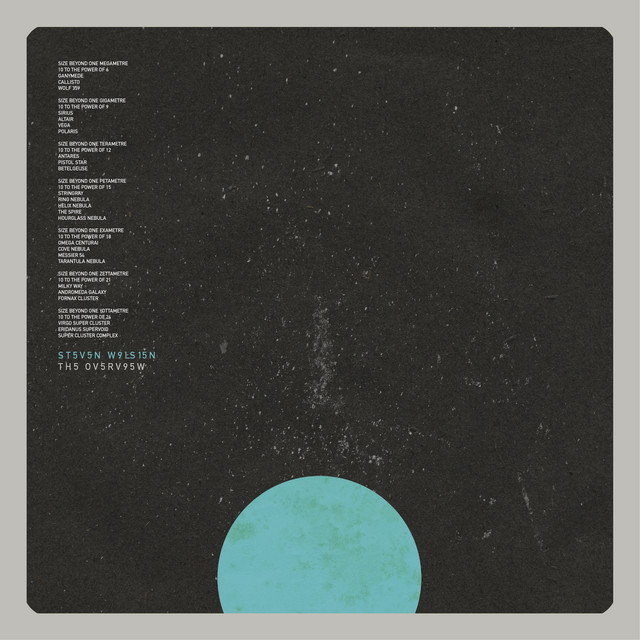
Well, it’s 2025 and Steven Wilson just put out an honest to god, Pink Floyd-ass prog album. Like, it’s even about space! So I’m enjoying that.
And Coheed also just released an album that has a shape similar to their early records. It’s not as good as Good Apollo, but it’s probably as good as we’ll get at this point. And that’s OK in my book.
What about y’all? What are you listening to?

 subjunctivitis