
Summer Games Done Quick 2025 kicks off today. It’s a week-long charity marathon featuring speedruns and other video game showcases, the latest event in a biannual series that has been going for more than a decade. I want to talk briefly about why I make time to watch these events whenever they come up.
But first, I need to spoil all of Mobile Suit Gundam.
Actually, there’s way too much to get into with Gundam. Colonies and spacenoids, Zeon and the Federation, mobile suits and Minovsky particles, and the One Year War and everything during and after that—we’d be here all day (I am going to spoil the end, though).
Instead, I just want to talk about Newtypes.

Within the Universal Century timeline of Gundam, a Newtype is a person who has supposedly reached the next stage of human evolution. The theory is that humanity would have to evolve so we can adapt to living in space. This evolution has nothing to do with bone density, radiation, and all the actual reasons we can’t survive up there long-term. No, the brainchild of series creator Yoshiyuki Tomino, this evolution instead means expanding our minds.
Newtypes exhibit heightened physical awareness—they have better reaction time, are quick to read any situation, and are generally better at multitasking, among other things. Within the fiction, the Adults in the Room look at Newtypes and think “Wow, you would make an incredible killing machine. Have a seat inside this giant robot, son.”
However, the other notable characteristic of Newtypes is that they also have heightened emotional awareness. They can sense what other people are feeling, and in high intensity environments (let’s say, the battlefield) they can essentially read minds. This makes Newtypes pretty terrible soldiers, though the top brass of each belligerent either fails to realize that or, more likely, doesn’t care.
This is the tragedy of the Gundam pilot. People who have the means to truly understand one another meeting on the frontlines of a war where they are not allowed to understand one another.
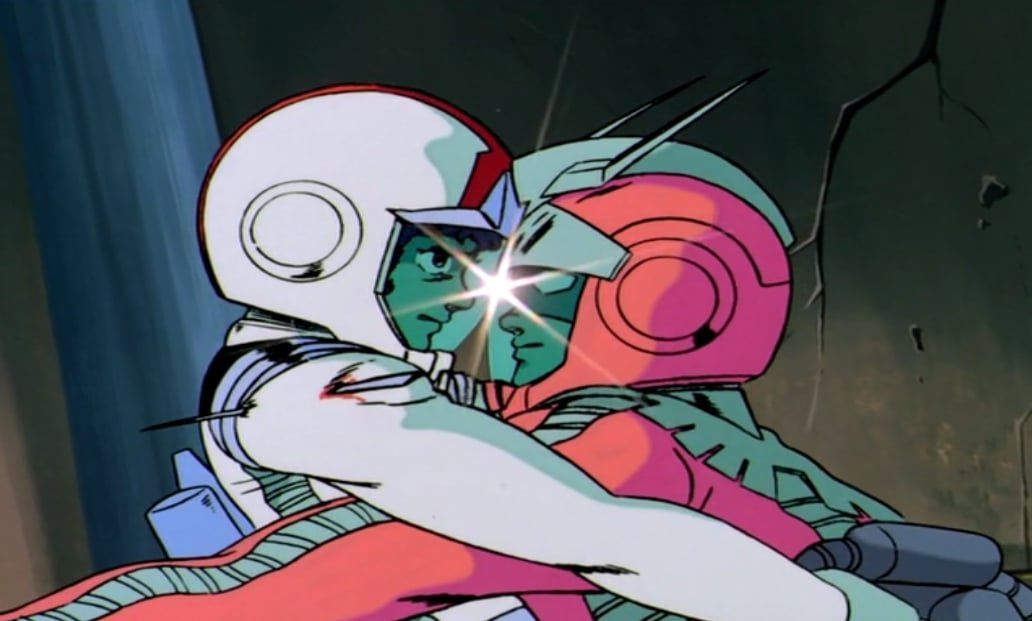
So it goes. Through 14 years of in-universe conflict, Newtypes awaken and go to war. Many of them end up dead; all of them end up broken. Despite being an article of pop culture that is perpetuated to sell merchandise, the stories Tomino chooses to tell through Gundam echo with a singular sadness. Victory is almost always bittersweet, and one conflict’s end signals the ignition of the next. If the heroes survive, they live to see new people make old mistakes.
While he has gone on to work on other Gundam series, the culmination of Tomino’s original work is 1988’s Mobile Suit Gundam: Char’s Counterattack. The dual protagonists of the first series and the original Newtypes, Amuro Ray and Char Aznable, reprise their rivalry in a final confrontation. Char, convinced that humanity cannot reform of its own volition, embarks on an accelerationist scheme to make Earth uninhabitable by dropping an irradiated asteroid on it. Amuro opposes him while serving as a willful tool of the corrupt Earth Federation, still believing in all the good that humans are capable of in spite of an unjust world. Here, two Newtypes come to blows, demanding the other answer for their failures.

In their final battle, Amuro narrowly bests Char, destroying the latter’s machine and catching his escape pod. Still, Char laughs as the asteroid enters freefall, confident that his plan has succeeded even if he lost the duel.
Invoking the one constant of the series, Amuro reminds Char never to underestimate the power of the Gundam. He flies around to the other side of the falling rock and puts the Gundam between it and Earth, maxing out his thrusters.
It seems futile. One mobile suit, no matter how powerful, can’t change the trajectory of so massive an object.
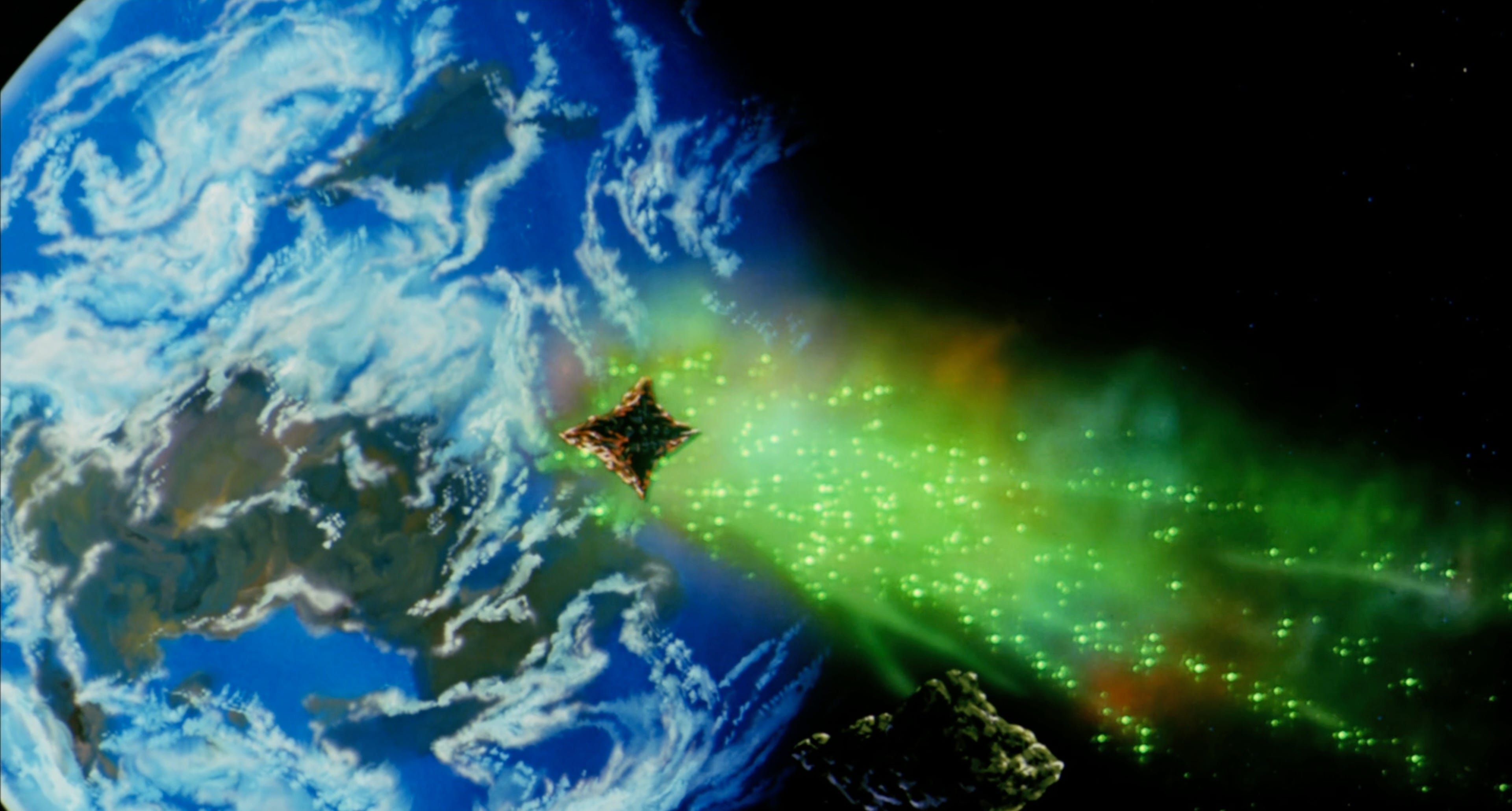
And then light surrounds the two men, an emerald radiance. In the novelization, Tomino calls it a “cosmic rainbow.”
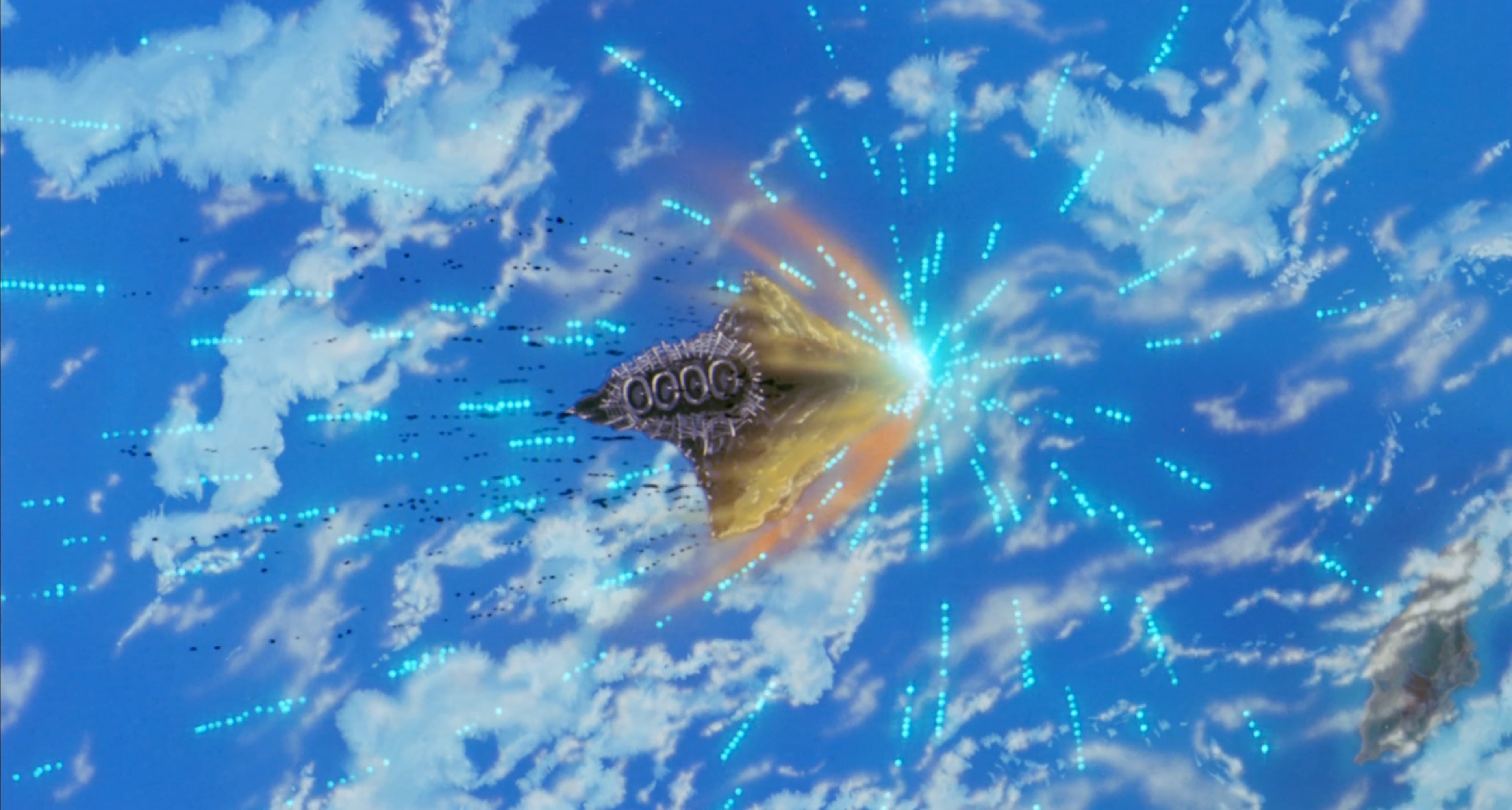
Other mobile suits arrive, helping to push back the asteroid. Many of them are Amuro’s allies, but some are from Char’s army. Amuro insists that they fall back, that their machines can’t hold up in these circumstances. He’s right. Some of the mobile suits combust. Others lose power and tumble away, helplessly. There’s a blink-and-you-miss-it moment where one machine reaches out a hand to catch one that had been his enemy five minutes earlier. Amuro feels each death, agonized that others would sacrifice themselves when he thought his sacrifice alone could avert catastrophe.
At the same time, Char feels only warmth as the light grows brighter. No fear. No despair. Sensing Char’s confusion, Amuro claims this is the light of the human heart. And Char then realizes the same hearts that are capable of cold cruelty are also capable of this unspoken resonance.
There’s no understanding between Amuro and Char, though. They bicker into their final moments, confounded by the other even as the light consumes them.
Miraculously, the asteroid changes course and floats away from Earth.
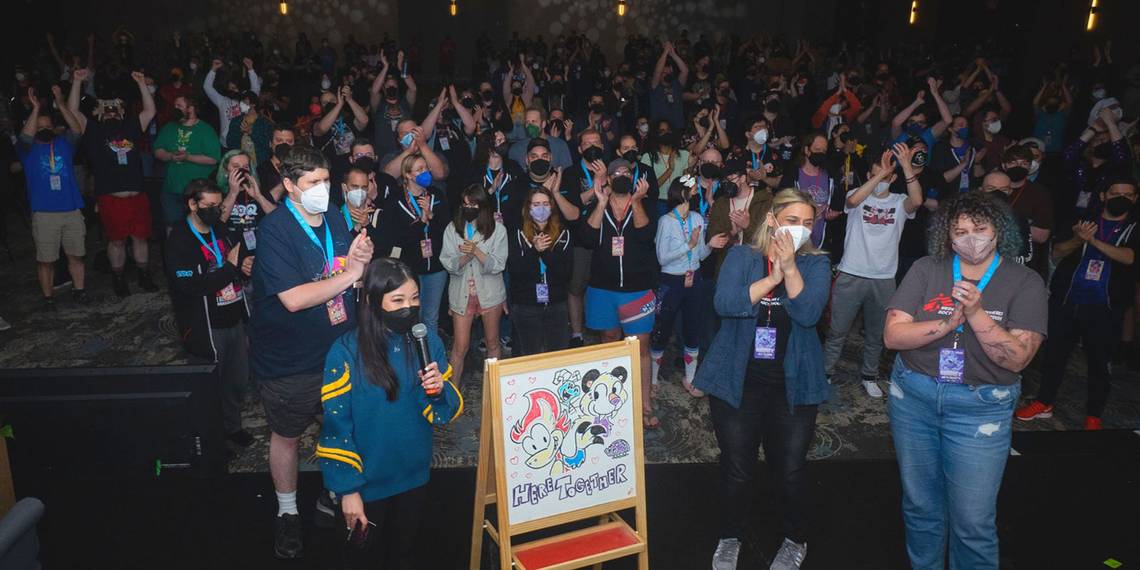
Since 2016, it has felt difficult to believe real change is possible. Progress is so fragile, and the systems that might protect it are too often used to shatter it instead.
It might seem absurd, but GDQ is one of the things I hold onto as a reminder that good things still happen. Yeah, it’s a speedrunning marathon, but at the same time it’s much more than a speedrunning marathon.
The same event that showcases a live band playing along to Crazy Taxi or a guy beating Elden Ring with a saxophone is also about supporting critical causes and bringing people together.
Each January, Awesome Games Done Quick raises money for the Prevent Cancer Foundation, and each July, Summer Games Done Quick fundraises for Doctors Without Borders.
Those who are performing the speedruns are not only talented and entertaining, but also notably diverse and demonstrably kind. Throughout the week, donation messages are sent out with viewers and members of the wide speedrunning community writing in to tell jokes, share stories, and show support for the cause. The GDQ event organizers have worked hard to create a haven for marginalized people, a platform for community solidarity, and an unalloyed force for good.
It’s even a venue for miracles.
In the lead up to each GDQ’s finale, there’s usually a big push toward some lofty milestone. These events routinely raise upwards of $2 million now, but just like with speedrunning, the goal is always to set a new record.
So, as the final runner settles in and the people on the couch explain the ins and outs of the game they’re running, the commentary is steadily overtaken by the crowd calling out numbers. The live chat is moving faster than you can read, and all eyes are fixed on the donation tracker, watching the digits turn over. The energy in the room becomes frenetic as tens of thousands of dollars are raised in the span of minutes. It’s an atmosphere that pervades even out of a live stream.
And every time, all I feel while watching is warmth, like being bathed in gentle sunlight.
At an event in 2019, Tomino was asked which of Gundam’s themes means the most to him, and his response is telling: “We all must aim to become Newtypes.”
Gundam isn’t a series devoid of hope by any means, but the circular nature of its conflicts and the stubbornness of its characters might lead someone to believe that Tomino doesn’t think much of his fellow humans.
In reality, he just wants us to try harder to understand. We owe it to each other.
In the face of calamity, we’re supposed to say “Even so” and extend our hand.

 subjunctivitis